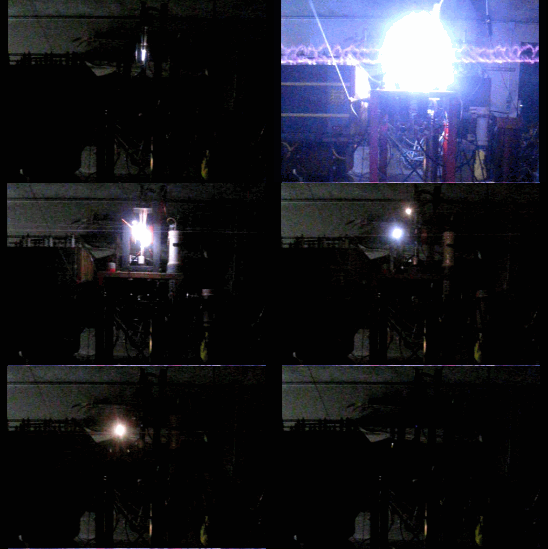
Ball-Lightning:

A HF Cavity Resonator ?

Dr. Paul-J. Hahn


It is shown that based on the HF-microwave-hypothesis of P.L. Kapitza1 the high energy storing capability of ball-lightning can be explained. If the microwave oscillates in the spherical skin of an ionised plasma ball the entity acts like an electrodynamic spherical cavity resonator, whose induced electromagnetic pressure leads to a self confining stable zone of high energy. This electromagnetic oscillator is unique for the possibility of storing tremendous energy in a free surface volume, simply and solely the one and only chance without any need for stressing 'para-physics'.


For a long time the real existence of the phenomenon ball-lightning was disavowed by official science. Too strange, exotic and unbelievable had been the reports of eyewitnesses and once again one took it easy: What scientists can not explain must not exist, politely shrugging off whether now the eyewitnesses are suffering highly disordered perceptivity, blowing up their fairy stories or simply lying. Unfortunately bygones linger on. Now even ball-lightning researchers fall back into this same old loophole, if their respective, beloved theory is absolutely not willing to explain the one or the other reported feature of ball-lightning.

There are at least two claims of fame of ball-lightning, in the following abbreviated by BL, as frustrating annoyance baring the way for theories : The sometimes reported capability for storing tremendous amounts of energy and the skill of penetration through panes of glass or even walls and roofs, sometimes without damaging the obstacle. To accept these reports of eyewitnesses is to cancel the actual BL-theories, all but one. The contempt for eyewitnesses is hardly to understand, remembering that there exists in fact already one (but only one!) physical explanation for the skill of penetration through obstacles: Based on the microwave-hypothesis by P.L. Kapitza1, Y.H. Ohtsuki & H. Ofuruton2 could demonstrate by their experiments, that microwave plasma discharges can easily penetrate through ceramic plates. Now this article at hand will show that the microwave-hypothesis could explain even BL's capability for high energy storing.

Via his microwave-hypothesis Kapitza tried to dodge the problem of lifetime versus energy storing, arguing that BL-lifetime could be supported by an outer source of electro-magnetic radiation and so would no longer have to rely only on an inner stored energy. But the question "how to store energy?" was swapped against "where to find the source of radiation?" and the capability for storing energy remained unexplained, an energy which, if we believe the eyewitnesses, sometimes bursts by boisterous explosions, often compared to explosives, sometimes even up to real bombs. Thus, meeting a ball-lightning researcher, it becomes the crucial question of 'to be or not to be': "How does Your theory store energy?"


The spherical cavity resonator

An answer to the problem of energy storing could be, if the microwave plasma fireball assumes the shape and structure of a spherical cavity resonator (shown in Fig. 1), being the final "degeneration" of cylindrical cavity resonators (Fig. 2). For the lowest oscillation mode the resonant wavelength lR correlates to diameter D by 3

lR = 1,14 D

Examples: The diameter range of mostly reported BL is marked by D = 1 cm and thus lR = 1,14 cm corresponding to a frequency of 26 GHz and by 30 cm giving lR = 34,2 cm at 0,9 GHz. The shown oscillation mode is only the lowest one and higher modes should be possible as well. Is this in accordance to eyewitness reports that sometimes BL falls to smaller cells - and vice versa?


The shell structure of ball lightning

As long low-energy-BL's don't show considerable ionisation of the inner gas volume this gas will fill up the whole sphere. But in case of high-energy BL's with full ionisation the strong microwave inside the cavity resonator sphere pushes the conductive plasma out of the inner volume, so that this plasma takes the shape of an outer shell, carrying the oscillating current in the skin of its outermost surface. This is shown in Fig. 3. and enables BLs to respond to pressure changes without changes to their outer diameter D. The combination of energy losses, decreasing oscillating currents and pressure drops will only increase the thickness of the plasma shell while the outer diameter remains constant, fixed to lR =1,14 D, well fitting to lots of reports. Contrary to the standard diagram in Fig. 3, these shell thicknesses are reasonable thin. In order to calculate their magnitudes, it is assumed that BL is generated by microwave pulses, so that the laws of isotropic thermodynamics can be applied. The pressure is calculated via the "specific density" of the stored energy (see next section). The results of these rough calculations are shown in Fig. 4: The shell thicknesses related to BL-diameter D are essentially stretched in a range between 10-2 to 10-6! Even if tremendous heating up follows the primary generation of the BL, the fact still stands that the plasma shells remain negligible thin. Consequently this BL-model is well fitting to lots of reports, telling about an hollow impression of the viewed BL, sometimes compared to soap bubbles, probably related to its particular parameters.

The stored energy

The meridian current crossing the equator and oscillating between the poles in the conductive skin of the ionised plasma ball generates at any time an inside vectored pressure, compressing the circumference, while the polar oscillating voltage gives at any time an axial belting coherence. Therefore the entity is self confining stable as long as the frequency is high enough and thus as long as there is no sufficient time left over for the thermodynamic pressure to break through at the nano-short 'zero-run-throughs of the oscillation. Apart from this there seems to be no limitation for the energy storing prima facie, as far as the velocity of sound, linked to the plasma temperature, remains negligible compared to the speed of light.

For the given oscillation mode the inductance L of the spherical cavity resonator is calculated by J.A. Stratton3:

L = 0,0385 m0 D

To get a feeling about the consequences the correlation of the stored energy E

E = ˝ L Ĩ²

to the microwave current Ĩ which crosses the equator is calculated as equivalent grams of TNT with its specific energy content of 4,54 kWs/g. The result (shown in Fig. 5) is, that correspondence to BL-reports needs currents in the range of 106 to 108A. This makes the acceptance of the suggested energy storing not easy - if at all there would be a better alternative, possible explanation for BL's energy storing. Next section will show, that currents of these magnitudes may not be as beyond belief as it seems to be at first sight regarding the extremely high circuit quality Q of the proposed cavity resonator.


The runaway-effect

The relationship between BL diameters D, resonant wavelength lR, capacitive/inductive stored energy and Thomson’s law result in a very simple equation between the oscillating current and the oscillating polar voltage:

Ũ [V]= 79.97 Ĩ [A]

The meridian distance pD/2 leads to a mean electric field strength Ẽ. The critical field strength for the runaway-effect is described by the Dreicer field ED

ED [V/m] = 4,5E-21 ne [m-3] lnL / Te [K]

A first evaluation follows the assumption of a microwave-pulsed isotropic generation of the BL to find values of ne and Te. Using lnL » 10 as first approach the results are shown in Fig.6, where the ratio Ẽ /ED is plotted against microwave current I: The polar field strength Ẽ exceeds ED by several magnitudes, i.e. the HF oscillation is carried by runaway electrons resulting in a total breakdown of the electric resistance which is already extremely low via "classic theories"3,4,5. Now this 'superconductivity' leads to two results: 1st: The circuit quality Q of the oscillator becomes nearly infinite, meaning, that the tremendous currents in the range of >106 A, needed for an appreciable amount of stored energy, require exciting currents lower by a factor Q in the range of "some Amperes". And such exciting currents seem to be absolutely feasible! 2nd: Together with the stored energies these 'Zero-like' energy losses are of major importance for a theoretical understanding of BLs lifetime.


'Floating around'

It is obvious, that BL can cover a wide range of stored energy, whereas its diameter is only in relation to the frequency and wavelength and thus more or less constant when the inner energy drops down or is pumped up, changing only the thickness of the shell. As already mentioned this is in very well fitting accordance to eyewitness reports and thus another trump of the microwave-hypothesis, as Kapitza already pointed to. May be that low energy BL are weak against air turbulence, don't have a strong tension to keep the ball shape and so are sometimes deformed to oval, longish, or even tube like appearance (as sometimes reported), similar to large soap bubbles. But the article at hand deals with the high energy types, which are obviously easier to evaluate theoretically. Although the process of initial formation of BL is not yet really understood, it is assumed, that a violent lightning discharge generates an microwave pulse, which catches an air volume maybe with some ionisable particles as first support (fireplace, chimney soot) and having a diameter corresponding to the microwave wavelength. Subsequently the pulse pumps up the caught volume (see section 'shell structure'), increasing the temperature and pressure corresponding to the electromagnetic pressure while the diameter of the volume remains constant. But at least volume and mass of the sphere are not changed! That means, the ball density as a whole remains just the same as that of the surrounding atmosphere! If this would be not the fact, BL would strictly not be able to float around. This is another trump of Kapitza’s microwave-hypothesis! Small variances in density result in BLs which climb up to the clouds or sink down to the ground, well matching to lots of eyewitness reports.


Outlook

Lucent flickering microwave clouds are easily to generate, even at home, putting a candle into ones microwave oven. But as proof of the proposed energy storing theory such lab-experiments are completely improper. Real high energy discharge experiments are obviously needed, not yet really knowing the specific experimental set-up or whether the instrumentation of even highly equipped research institutes will prove to be sufficient at all. Would it be easier to channel real natural lightnings into ones sophisticated device, just like G.W. Richman did, paid by his death (Petersburg, 1753)?

Or had such artificial energy-BL already been produced? When W. Ehrenberg6,7 came back from Argentina to Germany mid of the fifties he reported about the first large scale attack on nuclear fusion of Dr. Ronald Richter on the island of Huemul near St.Carlos de Bariloche/Argentina. Inside a "pole cross" of his discharge device Richter had produced high temperature, horrible 'plasma balls', he reported. Although Ehrenberg had essentially misunderstood the concept of the discharge circle not becoming aware of the high voltages and huge capacitors employed , it is remarkable, that Richter had spoken to him about values and conditions of resonance - not going into more details. Remarkable too that Richter considered the nuclear D-T-reaction as unfit for fusion reactor devices because of the severe problems coming up with tritium and the neutrons. Obviously his fluctuating short-lived "plasma balls' provided him with sufficient pressure and temperature stability to ignite the proton/He3-coupled chain reactions of Deuterium an Lithium6. Had Richter's 'plasma balls' been artificial ball-lightnings? Be that as it may: With its capability for storing tremendous amounts of energy combined with the self confining stable plasma confinement the spherical cavity resonator seems to be the missing link to the nuclear fusion reactor, no matter whether this phenomenon may be alias-called "ball-lightning" or not.


References:

1. Kapitza, P.L.: Über die Natur des Kugelblitzes

Physikalische Blätter, 14.Jg. 1958 Heft 1

2. Ohtsuki, Y.H. & Ofuruton, H.

Plasma fireballs formed by microwave interference in air

NATURE, Vol 350, 14. March 1991

3. Stratton, J.A.: Electromagnetic Theory, New York/London 1941, Sec. 9.24

4. Janzen, G.: Plasmatechnik, Heidelberg 1992, Gl. 2.1.79 - 2.1.81

5. Meinke, H. & Gundlach, F.W.

Taschenbuch der Hochfrequenztechnik, Berlin 1968, Kap. A3 u. G8

6. Ehrenberg, W.: Probleme und Möglichkeiten der Atomkernfusion

Moser Verlag München/Garmisch Partenkirchen 1958,

7. Ehrenberg, W.: Die argentinischen Kernfusionsversuche in neuem Licht

Atompraxis, 4. Jahrgang April 1958, S. 139/140


Legend of Figures

Fig. 1 The Ball-Lightning as Spherical Cavity Resonator

Fig. 2 Steps of Degeneration to the Spherical Cavity Resonator

Fig. 3 Shell Structure

Fig. 4 Shell Ratio s/D vs. Microwave Current Ĩ

Fig. 5 Stored Energy E vs. Microwave Current Ĩ

Fig. 6 Ratio of the Electric Field to Dreicers Criterion vs. Microwave Current Ĩ

Acknowledgement

My search for the origin of ball-lightning began, when in 1969

W. Ehrenberg6,7 inflamed my interest in R. Richters experiments.

This article is dedicated to his daughter Monica Richter.

It is due to her, that the scientific inheritance of her father Dr. Ronald Richter

is not lost, which has always been my guideline of research.


Correspondence:

Dr. Paul-J. Hahn

Hanauer Str. 60

D-77731 Willstätt-Sand/Germany

Tel.: +49173 54 55 777
e.mail: paul-j.hahn@t-online.de

   www.p-j-hahn.de                     Druckversion


Folie 1 wird geladen
Folie 2 wird geladen
Folie 3 wird geladen
Folie 4 wird geladen
Folie 5 wird geladen
Folie 6 wird geladen
      back